


Does Your Business Have the Secret Sauce that Venture Capital Craves?
- Niagara Action

- Feb 16
- 4 min read

Special Report: The 2026 Venture Outlook
INTRODUCTION: A PERSONAL PERSPECTIVE
Many people have asked me recently: How did you get into venture capital, and why did venture capital invest in your company?
To provide clarity, I want to explain what venture capital looks like today for a deal like mine. There is no question that this article does not cover the entire universe of investment triggers; it is based strictly on my specific experience and industry. However, the lessons here are universal for any founder looking to scale.
THE HOOK: WHAT VCs
ACTUALLY CRAVE
In the current vintage of venture capital, the "idea" is no longer the currency—execution is. At Verite Capital Partners, we aren't just buying into a product; we are buying into a Market Leadership trajectory. We look for a "Unicorn DNA" composed of three non-negotiables:
1. Defensible Innovation: Can your business survive innovation, price wars, legal battles, regulatory hurdles, and even organized crime unleashed by your competitors? If you are easily disrupted, you are not defensible.
2. Operational Efficiency: Can you grow without hemorrhaging cash?
3. The Will to Lead: Do you have the infrastructure to capture 50% of your niche, or are you content being a feature in someone else’s ecosystem?
If you can't demonstrate all three, you aren't a venture-scale business; you’re a lifestyle company.
THE EFFICIENCY MANDATE: RATIOS THAT MATTER
In 2026, capital is "expensive," and the "growth-at-all-costs" era has been relegated to history. To secure a seat at the table, your "Magic Number" must be backed by rigorous efficiency AND proven operational experience.
Over a decade ago, the CEO of Metalico told me: "I don’t invest in businesses, I invest in management." That wisdom remains the bedrock of modern investing.
• The Burn Multiple (1.0 – 1.5): This is the ultimate health check. If you spend two dollars to generate one dollar of Net New ARR, you don’t have a business; you have an expensive hobby.
• The LTV:CAC Ratio (3:1 Minimum): In my experience scaling Buffalo Biodiesel, the moment your acquisition cost encroaches on your lifetime value, your scalability vanishes.
• The Rule of 40: The sum of your growth rate and profit margin must equal or exceed 40%. This ensures you can survive market volatility while remaining an attractive acquisition or IPO target.

RAISING IN "STACKS": THE STRATEGIC TRANCHE
The era of the $20M "blind" check is over. We are seeing a rise in Stack Funding. This involves a single investment round released in performance-based tranches:
1. The Launch Stack: Initial capital to finalize the MVP and core team.
2. The Traction Stack: Released only upon hitting predefined Revenue or User Milestones.
3. The Scale Stack: Unlocked for national expansion.
This "stacking" method de-risks the investment for Limited Partners while allowing the founder to preserve equity by proving value before the next tranche of capital is "priced" or released.
THE "DUAL EDGE": IP AND REGULATORY STRATEGY
To achieve true market dominance, you must leverage the synchronization of Intellectual Property (IP) and Regulatory Intelligence.
• The IP Edge: Patents and trade secrets are strategic weapons. They create a "Freedom to Operate" window, giving you a multi-year head start and acting as a 3x valuation multiplier.
• The Regulatory Edge: Treat regulation as a catalyst, not a hurdle. By integrating regulatory strategy into early R&D, you can identify "fast-track" pathways, shaving 12–24 months off a product launch.
• The Synergy: If you have IP but no regulatory path, you have a science project. If you have a regulatory path but no IP, you have a commodity. Market leaders own the intersection.
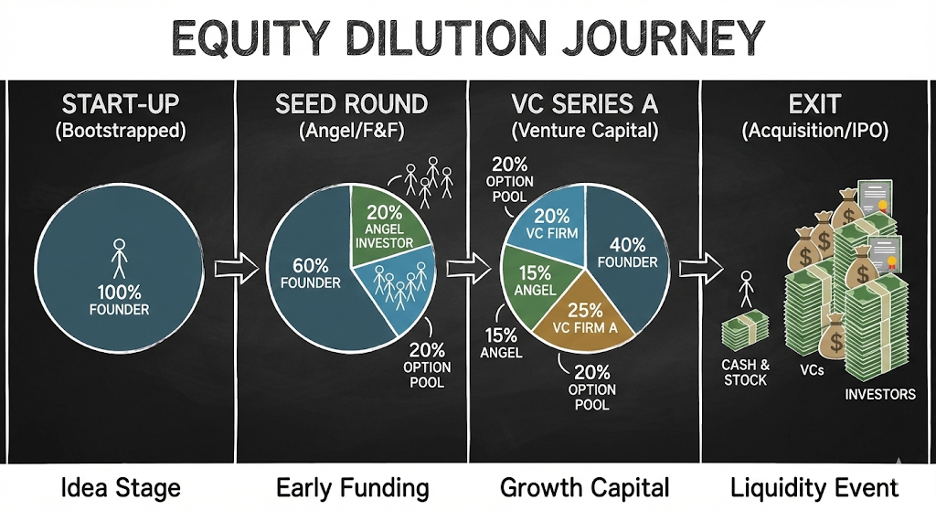
MARKETING EVOLUTION: FROM CONCEPT TO LEGACY
A business is a living organism; its voice must change as it grows. At Buffalo Biodiesel, our marketing today looks nothing like it did at the conceptual stage.
• Conceptual Phase (Founder-Led): Focus on "The Why." You are selling a vision to early adopters through direct community engagement and waitlists.
• Growth Phase (Performance Marketing): This is purely mathematical—optimizing your CAC through digital channels to prove the "Machine" works.
• Established Phase (Brand Equity): At this stage, you are building a "moat." Marketing becomes defensive, focusing on reputation, industry leadership, and customer retention. You are no longer introducing yourself; you are asserting your dominance.
If you meet the requirements for VC, congratulations you are an operator with a solid business. There are plenty of strong concept start-ups that never succeed or meet their growth potential due to operational challenges that include capital and management. The next article will be about financing for small businesses and how to obtain seed capital and growth capital.

-----------------------------
ABOUT THE WRITER
Sumit Majumdar is a lifetime environmentalist who has served as the CEO of Buffalo Biodiesel Inc. for over 20 years. He recently joined Verite Capital Partners as a Limited Partner.
Majumdar is currently being personally mentored and coached by Don Jones, the Chairman of Verite Capital Partners. A titan in the retail space, Jones holds significant positions in the medical and education sectors and previously worked for industry icons like Steve Jobs and Charles Schwab, to name a few.
A regular contributor to Bloomberg Green Markets, Majumdar has held positions on the boards of publicly traded companies and has served as CEO for companies listed on both the Nasdaq and Frankfurt stock exchanges. He is the recipient of the Patriotic Employer Award from the Department of Defense and has received numerous accolades for his commitment to the community and the environment, including honors from the New York State Senate.
Does Your Business Have the Secret Sauce that Venture Capital Craves?


Comments